Green hydrogen is widely regarded as a key energy vector in the energy transition. This claim is based on data regarding its environmental performance obtained through tools such as life cycle assessment (LCA).
LCA allows the evaluation of the environmental impacts of a product, process, or service throughout its entire lifecycle. This means looking well beyond the laboratory or factory floor. In the case of green hydrogen technologies, our LCA studies include the extraction of raw materials, the manufacture of electrolysers, as well as the use and transport of hydrogen. This powerful tool also helps identify opportunities to minimise these impacts, such as reducing resource consumption, lowering emissions, or improving waste management.
The challenge is that, as the number of hydrogen technologies and applications continues to grow, each LCA must be adapted to the specific characteristics of each technology. As a result, comparing technologies consistently becomes increasingly difficult.
“LCA has, broadly speaking, three main aims in the context of hydrogen: to support eco-design, to compare different technologies, and to compare hydrogen with alternative technologies that provide the same function. We therefore need a framework capable of addressing all three types of questions. Otherwise, LCAs used for eco-design and those used for technology comparison will not be consistent with each other”, says Gabriel Magnaval, ANEMEL researcher at the University of Applied Sciences and Arts Western Switzerland (HES-SO). But, luckily, at ANEMEL we have achieved a solution.
In an article recently published in the journal Energy & Environmental Science, with Magnaval as first author, our researchers have proposed a harmonised methodological framework for the LCA of the green hydrogen supply chain that can be applied across a wide range of technological contexts and applications. To achieve this, we came up with a simple yet effective idea: modules.
The process tree of the developed LCA analysis is structured modularly, with each module representing a standalone building block that can be modified or replaced within the product system. This modular structure decomposes the supply chain into exchangeable units that represent specific life-cycle stages or components, making it applicable to describe the value chain of any green hydrogen technology.
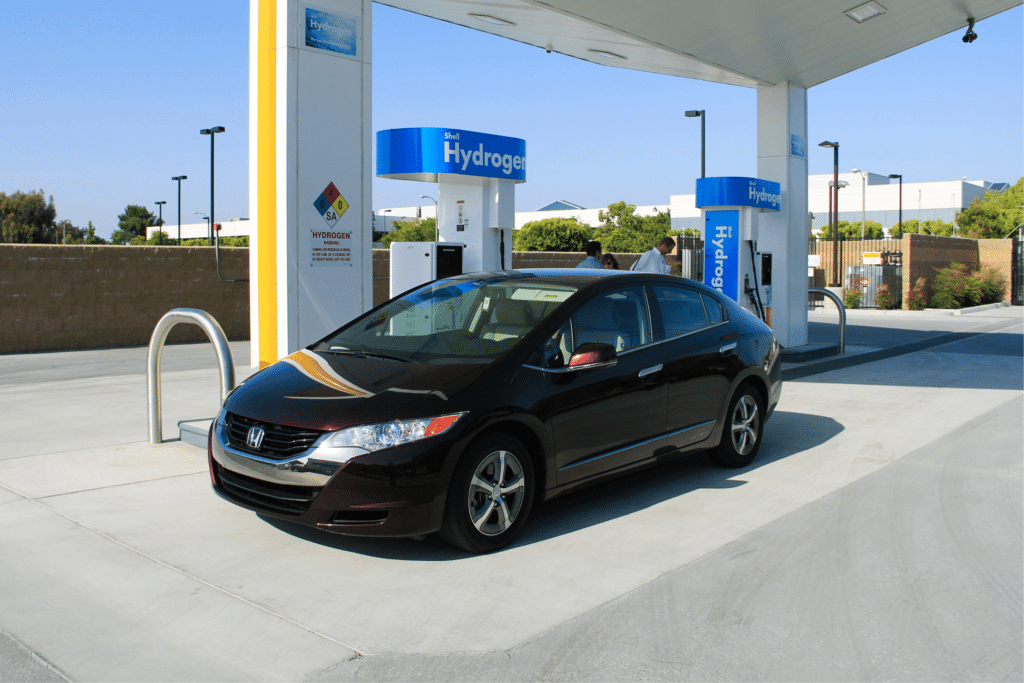
For instance, if hydrogen is burnt immediately after production to provide industrial heat, there is no need for separate distribution or storage processes. By contrast, if hydrogen is used in a fuel-cell vehicle, the assessment must include the production of hydrogen, its storage at a refuelling station, and the fuel cell itself, which reconverts the hydrogen into electricity.
Magnaval compares it to LEGO game: “We developed the different elements of the supply chain piece per piece, module per module. Then we focused in greater detail on the electrolyser, as this is where our industrial partners have the greatest knowledge, so we can achieve the most detailed LEGO pieces”.
Developing this LCA framework involved defining the modules or functional units (what function do we need?), quantifying all the flows (what do we need to fulfil this function?), and building the inventory (how much of each element is required to deliver the intended function?).
One of the first challenges was that the functional units differ depending on the hydrogen application. We focused on six potential applications of hydrogen, defining one functional unit for each. “For instance, one tonne-kilometre of product transported by a vessel using hydrogen as a fuel, or one kilowatt-hour of industrial heat supplied by hydrogen,” says Magnaval. Once the functional units had been established, we could construct the entire process tree – which would include all the processes in a system’s lifetime to fulfil the final function associated with each unit.
For the inventory, all ANEMEL partners contributed providing data. However, to improve both transparency and comparability, we developed a parametrised inventory. “Parametrised means that all the flows of the system have been defined as physical equations rather than just fixed numerical numbers”, explains our researcher. So, for instance, instead of including amount of energy consumed by the electrolyser to produce one kilogramme of hydrogen, we included parameters such as system voltage, current density of the cells, and the size of the different system elements.
“With this information, we can calculate the energy consumption ourselves using physical equations from the literature and from our understanding of the system,” Magnaval says. This approach makes it easier to control and verify the raw data, as many parameters can be measured directly on the system itself.
The framework has been implemented in a dedicated LCA tool available in two versions. One version focuses exclusively on CO₂ emissions in the climate-change impact category and is openly accessible because it relies only on literature-based data. The second version is intended for LCA practitioners and requires a specialised licence.
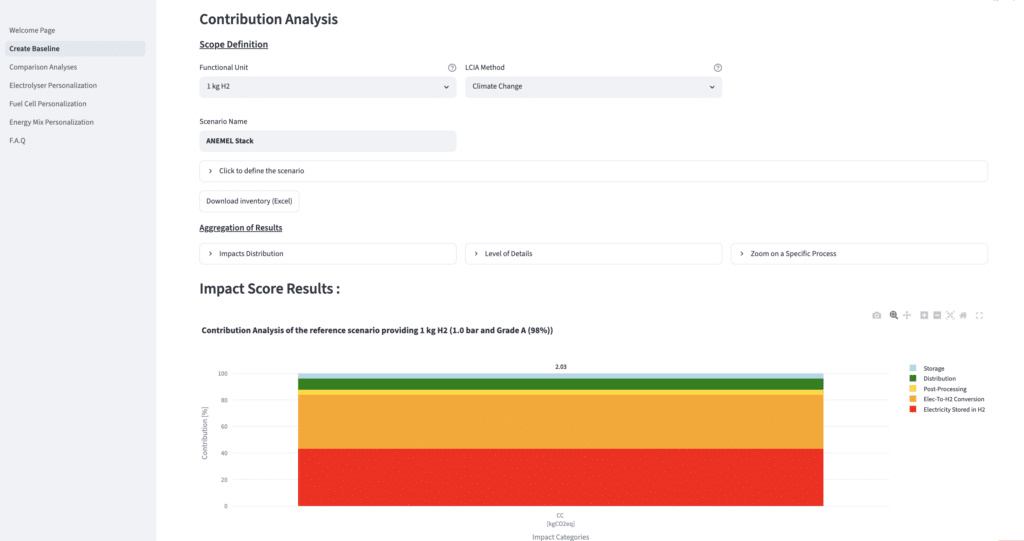
Using this framework, the researchers obtained several important insights. One of the most notable findings is that energy consumption is often underestimated in LCAs.
“One important point with hydrogen is that there are significant energy losses throughout the supply chain. This explains why, in most cases, direct electrification performs better than hydrogen,” says Magnaval.
This is why hydrogen appears to be particularly relevant for sectors that are difficult to electrify directly, such as chemical production or long-distance shipping, rather than car mobility or domestic heating, “where we already have technologies that are more mature and more efficient than hydrogen-based solutions.”
Thanks to this new framework, researchers can now build cumulative and comparable knowledge about hydrogen technologies, enabling more consistent assessments and a deeper understanding of the field.
This work forms part of a collaboration with the European projects PressHyous and Sustaincell. We also acknowledge the contributions of the study’s co-authors: Maël Mouhoub, Manuele Margni and Anne-Marie Boulay, and with special thanks to Eleonora Crenna for representing HES-SO in ANEMEL.