Building an electrolyser is like making a sandwich: between its housing, the different components are layered one over the other in repeating units called cells. The membrane electrode assembly, or MEA, is the assembly of each cell’s core parts and the main focus of this blogpost.
A MEA is formed by an anode, a cathode and a membrane. Ensuring that we achieve the best possible MEAs is the focus of our researcher Arthur Thévenot, the protagonist of this new edition of #MeetOurPartners. Thévenot has been part of ANEMEL since the beginning of his PhD at Technische Universität Berlin (TU Berlin), in Germany, in the research group of Peter Strasser.
“My research topic is centred around AEM [Anion Exchange Membrane] water electrolysers operating with various electrolyte feeds, including alkaline, pure and saline water”, he explains.
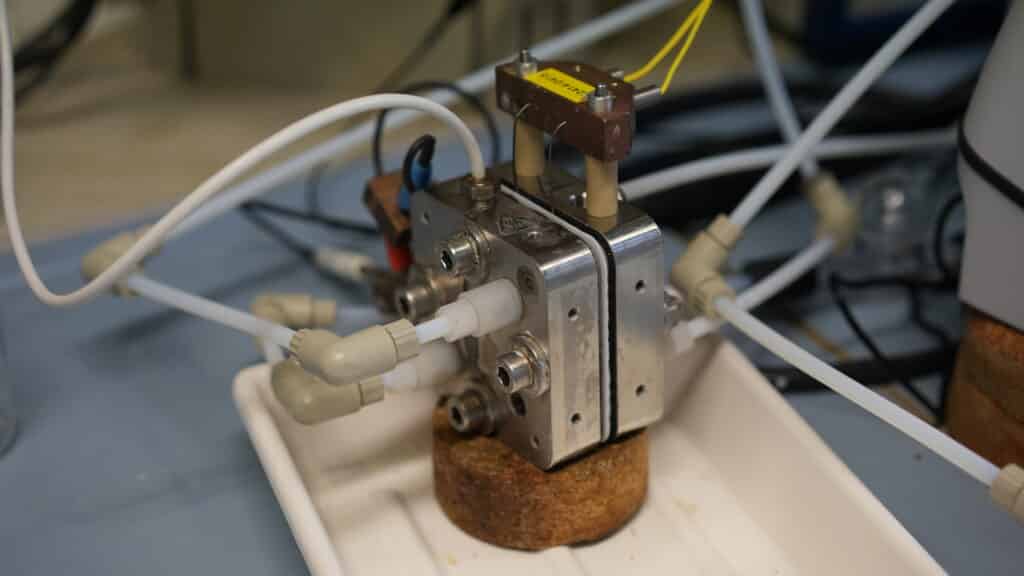
Within ANEMEL, his work focuses specifically on the preparation, assembly and performance assessment of the anode, the cathode and the anion exchange membrane. This means he is part of Work Package 3 (WP3), a team focused on the electrolytic cells. “Compared to the other members of WP3, my differential role is to test the MEA components from other partners and optimise the testing conditions to achieve the best performance”, he clarifies.
To do this, Thévenot performs electrolysis using a single-cell AEM water electrolyser. Indeed, this is simply an electrolyser composed of only one cell, and very small one, as our researcher typically works with 5 cm² MEAs. By this means, he can assess the performance of the MEA for hydrogen production, as well as its durability. Following his work, WP4, which specialises in stacks, will scale up the optimised MEA from the single cell into a larger electrolyser composed of multiple cells.
At an early stage in ANEMEL, he first used benchmark materials: materials that were already developed, either commercially available or previously reported in the literature. After optimising conditions with these benchmark materials, Thévenot then moved on to testing the materials from our partners.
“For example, thanks to these benchmark studies, we found that applying a layer of ionomer on top of the cathode catalyst layer significantly improved performance in low-alkaline media, which helped our partners from De Nora with the design of their cathodes,” he explains. De Nora is, in fact, the ANEMEL partner Thévenot has worked most closely with, as they are responsible for fabricating the electrodes. This work on ionomer architecture was published in an ANEMEL paper. Read more about it here, or watch our webinar with Thévenot himself here.
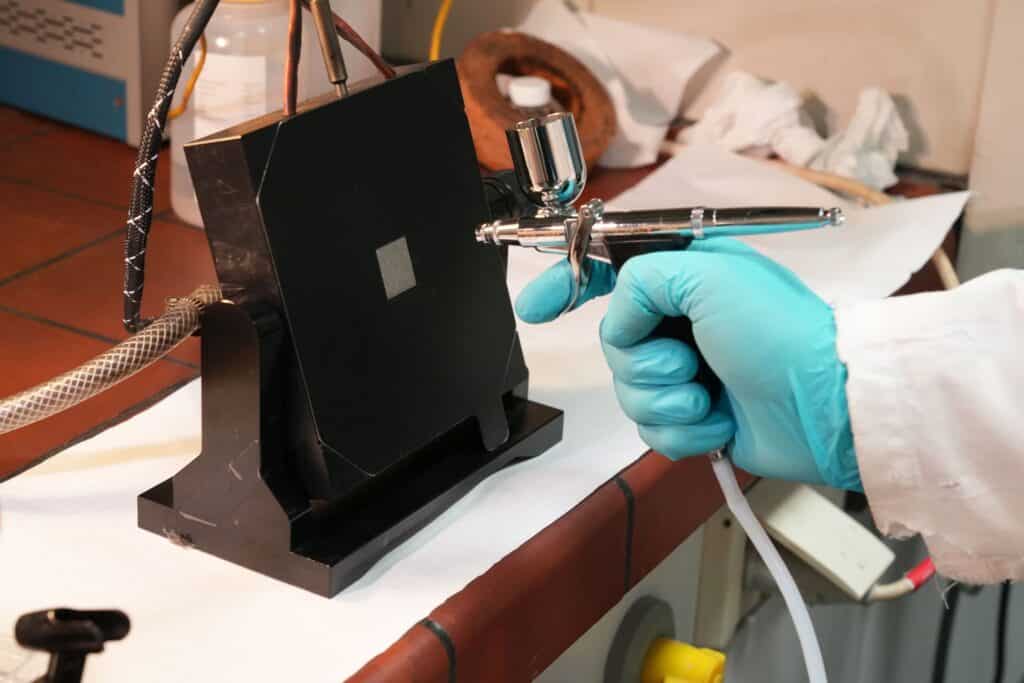
Optimising conditions means for Thévenot rolling up his sleeves and preparing—and improving—the different components himself to see how they perform best: spraying catalysts, preparing a top layer of ionomer, soaking the membranes to “activate” them, and much more lab work that goes beyond simply assembling and testing the components. His duties also include taking into account different conditions, such as various porous transport layers and different configurations for the electrolyte feed.
“The AEMWE’s performance is not only influenced by the MEA and the interactions between its different layers but also by various additional parameters, including the electrolyte itself, the mass transport within the cell, and even the electrochemical testing protocol!”, he says.
Currently, the tests our researcher is focused on are aimed at supporting the selection of the pieces that will be used to build the final ANEMEL stack, as well as addressing the final challenge of operating it efficiently and continuously for 2,000 hours. Good luck to us!